A Look Inside the Company – HUG AG
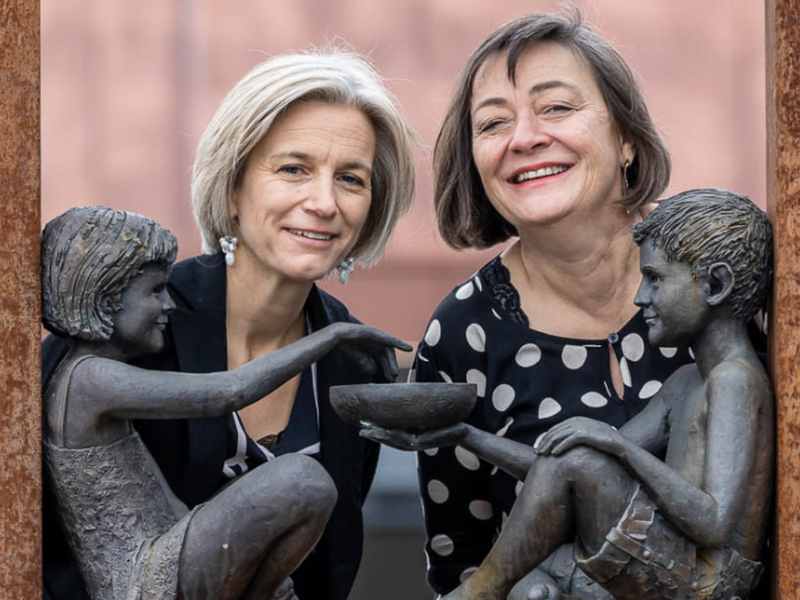
HUG AG is one of Switzerland’s best-known cookie manufacturers. The company is co-managed by Anna Hug and Marianne Wüthrich-Gross. Anna Hug has also served on the board of Lucerne Business since 2025. We had the opportunity to speak with her about honesty, a “culture of apology,” and Ovo-DAR-VIDA.
The foundation for HUG AG’s success was laid as early as the 19th century: On August 1, 1877, 26-year-old master baker Joseph Hug-Meyer took over the Zumbühl bakery on Weggisgasse in Lucerne. According to the company’s history, one day he accidentally placed sliced bread in the oven instead of loaves—and thus, quite by accident, invented the Zwieback. This was followed by a story spanning five generations: first with Zwieback, later with biscuits — heralded by the Nuss-Ringli as the first HUG cookie.
HUG AG’s products remain popular and widely recognized to this day. In addition to HUG Zwieback and DAR-VIDA, the company — which has been family-owned for 150 years—also owns the well-known Wernli brand. Anna Hug represents the fifth generation. She joined the company in 2010 at the age of 39 with no ambitions for a leadership role; she has been on the executive board since 2015 and has served as co-CEO alongside Marianne Wüthrich-Gross since 2022.
Would you recommend the co-leadership model to other companies?
It was important to me to be able to balance my role as a manager with my family life, which is why I was determined to work part-time. This led to a co-management arrangement, with each of us working 70 percent of full-time hours. Initially, I shared the management role with my uncle Andreas Hug, who was the CEO at the time. After two years, Marianne Wüthrich-Gross took over this role. The collaboration worked very well in both setups from the very beginning, which is why I can highly recommend this model based on my own experience. Co-leadership is an excellent option, especially for employees who work part-time.
I’m increasingly realizing how valuable this model is when it comes to succession planning: the older generation still has a foot in the door and is there to support the younger generation. I’ve observed this generational transition at several companies. But you also have to be the right type of person for it: There are certainly young people who want to decide everything on their own and don’t want to be talked into anything. And then there are older people who can’t let go. That’s when it gets challenging.
Is running your own family business different from running a company that isn't your own?
In a family-owned business, you’re very much in the spotlight. Everyone is watching closely to see what you do. But the name helps—for example, when you’re trying to secure a meeting with a client. And yes, there is a certain difference when you’re making decisions for your own company. It’s hardly noticeable at first glance, but upon closer inspection, you realize: Running your own company demands absolute honesty. You think twice, especially when it comes to issues like sustainability. There were ideas that, while obvious, didn’t feel right for us. So we rejected them. Instead, we embraced approaches that might have seemed less trendy and went against the grain, but were more effective in terms of environmental protection. Running your own company requires a lot of courage—you have to stand by your decisions and be able to stand your ground when complaints arise.
What sets HUG AG apart as an employer?
One of the most important things that sets us apart from others is the strong involvement of our employees: we include them in decision-making processes and give them a great deal of responsibility. We embrace a “sorry” culture: we’d rather have our people make a decision and say “sorry” afterward than constantly ask for permission beforehand. It’s important to us to keep moving forward. We all want to make a difference and help shape the future together. That’s why all 440 of our employees are involved in a CIP (continuous improvement process). In this regard, we’re certainly ahead of other companies. We also place great value on our warm and welcoming culture.
We also actively promote internal career development: many positions are filled directly from within our existing team, and we invest heavily in our employees’ professional development. Overall, we offer a competitive benefits package that includes additional voluntary family allowances. In addition, we are actively involved in charitable work as a company: Every November, we host a massive event, the Chnusperhüsli Event, during which we raise funds for a charitable organization. On this day, around 20,000 people gather on our grounds, and 160 of our 400 employees are on duty all day. This also contributes to the positive atmosphere.
What role does sustainability play in your company?
Sustainability has always been a matter close to my heart. My father established our raw materials charter even before the turn of the millennium. Back then, HUG AG was already using only a minimum of additives and no preservatives. My uncle Andreas carried on this philosophy. For example, we are not required to use IP-Suisse sugar, which is particularly beneficial for biodiversity. Nevertheless, we do so out of conviction. We bear the additional costs ourselves. For about ten years now, the market has increasingly demanded solutions that promote sustainability, mainly through regulations such as the sustainability report.
Our products vary greatly in terms of sustainability. Some cookies are very sustainable—for example, the Willisauer Ringli, which use almost entirely Swiss ingredients. They also contain no milk or chocolate, making them slightly less sustainable. Even the packaging in the bag is eco-friendly. However, we don’t explicitly highlight this. Choco Petit Beurre, on the other hand, is also a very popular product, but it is slightly less sustainable because it contains milk and chocolate and uses a bit more packaging. Nevertheless, we maintain high standards here as well: We use chocolate certified according to Rainforest Alliance criteria, which means our standards exceed the industry average. We are also continuously working to reduce packaging materials.
What is the state of innovation at HUG AG?
We define innovation very broadly; it applies to both our processes and our products. Customers also demand innovative products—they breathe new life into our brand. What we’re seeing is that patience in the retail sector is growing increasingly short: if we aren’t on the home stretch after 12 months, the product is dropped from the lineup. We invest heavily in thinking about innovation. Nine out of ten ideas fail, which can happen at any stage—concept, feasibility, or even after launch. One in ten succeeds, as was recently the case with our DAR-VIDA Ovomaltine, of which we are very proud. It has a very high repurchase rate: the combination of taste and health is a good compromise, and the excellent reputation of these two traditional Swiss brands also contributes to its success.
How important is “Swissness” to the success of your company?

Anja Hammerich
Project Manager Communication/Content
Phone +41 41 367 44 08