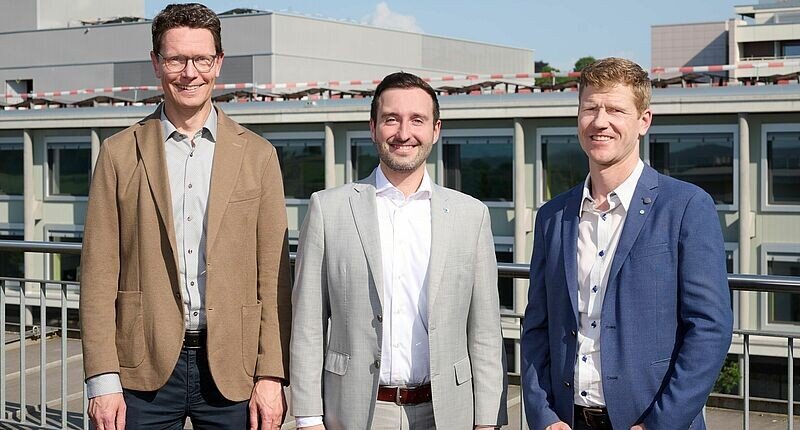
City of Lucerne supporting modern energy concept at the cantonal hospital
Lucerne - The city of Lucerne is putting money from its energy fund towards a modern energy concept for Lucerne Cantonal Hospital. The plan involves using waste heat from the clinics for heating and cooling. With this financial support to the tune of 270,000 Swiss francs, Lucerne is seeking to reduce locally generated greenhouse gas emissions.
The city of Lucerne is supporting an innovative energy project at Lucerne Cantonal Hospital (LUKS). The hospital plans to open the new children’s hospital and women’s clinic in the fall of 2026. Along with others on the hospital site, these units will be connected to a modern, sustainable heating and cooling network. According to a statement, the energy fund of the city of Lucerne is backing the project with funding of 270,000 Swiss francs.
The heating and cooling network – known as an ‘anergy network’, to use the technical term – works along the principle of storing excess heat generated in the summer underground so that it can be used during the winter months. Waste heat from the building is funneled into a ground storage system via 800 geothermal probes. In winter, this energy can be recovered for heating, while the buildings are cooled by way of geocooling in the summer. With this system, LUKS is aiming to save heating energy equivalent to the annual consumption level of around 1,400 households.
“For an urban setting, this is a very large-scale waste heat recovery project”, as Marco Baumann, Head of the Environment and Mobility Office of the City of Lucerne, comments in the statement. He adds: “Since the concept can also be deployed at smaller scale, it serves as a model for other locations”. Aron Duss, Head of Technology and Security at LUKS, sees the advantage of the energy network in its ability to use heat and cooling across multiple sites. “At the same time, we are enhancing operational reliability, which is crucial for providing the public with reliable medical care”, Duss states.
LUKS has invested around 11 million Swiss francs in the project. With this anergy network, the hospital will in future be less reliant on district heating from the Renergia waste-to-energy plant in Perlen. In this way, the freed-up heat can be used elsewhere in the district heating network to replace additional fossil-fuel-based heating systems there.