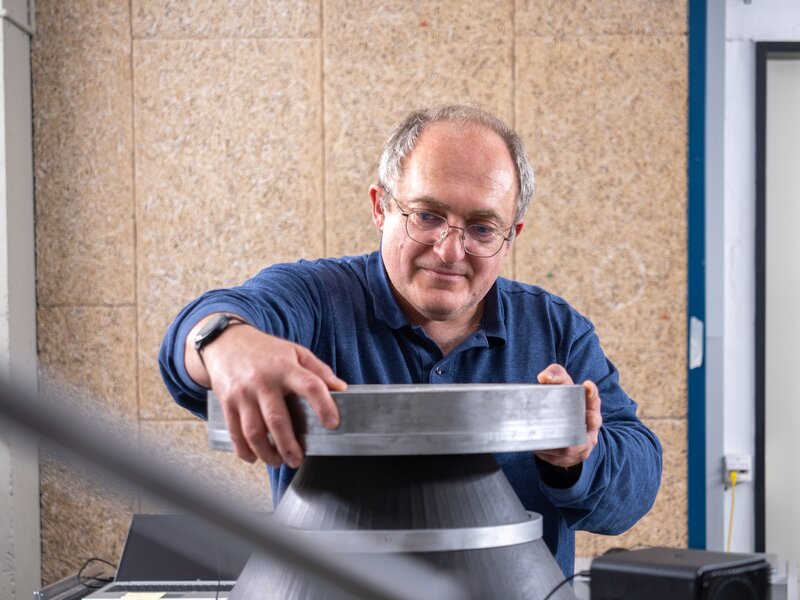
Empa and Beyond Gravity protect satellites during launch
Emmen/Dübendorf/Zurich - Researchers at the Swiss Federal Laboratories for Materials Testing and Research (Empa) have worked with the Zurich-based space company Beyond Gravity to reduce the vibrations that occur during rocket launches. This could help protect the sensitive electronics on satellites as they travel into orbit.
In collaboration with Beyond Gravity, researchers at the Empa Acoustics/Noise Reduction Laboratory, based in Dübendorf in the Swiss canton of Zurich, have developed a way to reduce vibrations affecting launch vehicle payloads. The research project which led them to this goal was supported by the Swiss innovation agency Innosuisse.
According to a statement from Empa, the research team focused on the Payload Adapter System (PAS) which is ocated at the tip of a rocket. The PAS was manufactured by Beyond Gravity in Emmen, in the Swiss canton of Lucerne, for the European Ariane 6 launch vehicle, among others. The PAS is shaped like a truncated cone and connects to the rocket at its lower end and to the payload at its upper end. The payload can consist of one or more satellites or space probes.
Spring elements are not an option for damping vibrations because the PAS must be lightweight and rigid. Instead, the researchers applied a concept from acoustics: phononic crystals. Rather than reflecting, scattering, or diffracting light for sound insulation, significantly larger crystals are used to redirect, reflect, and scatter sound waves.
Ultimately, instead of incorporating these crystals into the PAS, the solution that proved most effective was to transform the entire PAS into a phononic crystal. The new PAS structure is able to absorb low-frequency – and therefore particularly dangerous – vibrations, both in simulations and in experiments with a prototype. Beyond Gravity has filed a patent application for the invention.
The PAS must now be refined and optimized. According to research director Dr. Andrea Bergamini, however, the effort is worthwhile: «If we can better protect satellites against vibrations, we can send more sensitive measuring instruments into space – and possibly even adapt the requirements for building future satellites so that they become more capable and less expensive.»