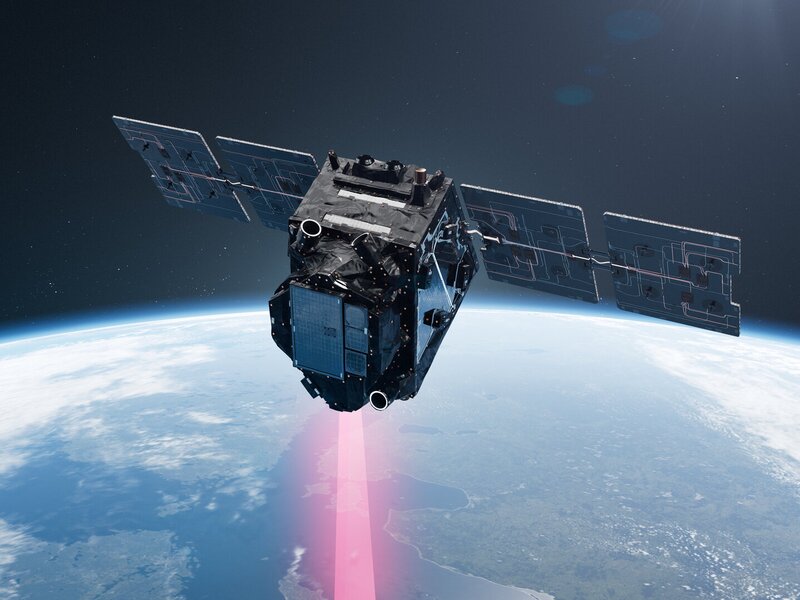
ESA satellites launch carrying Beyond Gravity technology
Zurich/Kourou - Two new European Space Agency (ESA) satellites were launched into space early in the morning of 15 September 2026, from the Guiana Space Center. Both satellites, like their European Vega-C launch vehicle, are carrying technologies developed by Beyond Gravity.
Beyond Gravity has contributed components to the ESA’s latest Earth observation mission. On 15 September, the European launch vehicle Vega-C, carrying the two satellites Fluorescence Explorer (FLEX) and Sentinel-3C, lifted off at 3:21 a.m. Central European Summer Time from the Guiana Space Center in Kourou. The Zurich-based aerospace supplier Beyond Gravity provided key technologies for both the satellites and the rocket.
With the new Earth observation satellite FLEX, ESA aims to map stress responses in plants worldwide, providing precise data for climate and agricultural research. The mission relies on an extremely faint fluorescence signal that allows scientists to draw conclusions about photosynthesis and plant health.
For FLEX, Beyond Gravity served as the Design Authority for the mechanical and thermal architecture of the satellite platform, suppling several critical subsystems. One of these is the launch structure, which weighs just 80 kilograms but supports the satellite’s total mass of 400 kilograms – more than four times its own weight.
Technology developed by Beyond Gravity for the Sentinel-3C satellite includes components for both the satellite structure and the solar panel alignment mechanism. The satellite is designed to monitor rising sea levels, heat waves, and wildfires, as well as ocean temperatures, algal growth, water quality, and El Niño events.
Beyond Gravity also contributed to the launch itself. The company manufactured the nine-meter-long payload fairing, the nose cone of the European Vega-C launch vehicle, which protects both satellites from extreme thermal, acoustic, and mechanical stresses during launch. The fairing was built at Beyond Gravity’s Emmen site in the Swiss canton of Lucerne.
“We are proud to contribute technologies for the entire mission,” CEO Dr. Barbara Frei-Spreiter is quoted as saying. “Our involvement reflects Beyond Gravity’s position as a reliable partner for complex Earth observation programs and underscores the strength of European industrial cooperation.”