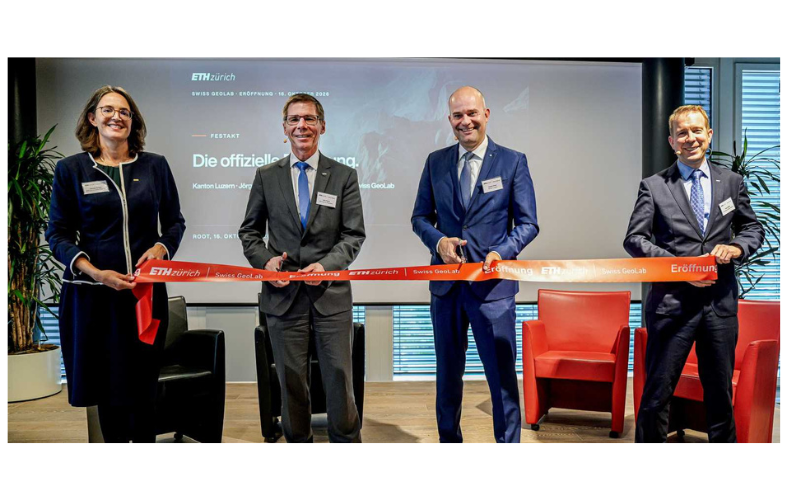
ETH inaugurates Earth observation competence center in Root
Root/Zurich - The Swiss Federal Institute of Technology in Zurich (ETH) has opened its new Swiss GeoLab in Root. It is intended to contribute to the early detection of natural hazards and the optimization of agriculture and forestry. Moreover, a platform based on Artificial Intelligence (AI) is in the pipeline too.
Just under 12 months since announcing its plans, ETH Zürich has inaugurated its new competence center for Earth observation. Located at the D4 Business Village in Root in the Swiss canton of Lucerne, the ETH Swiss GeoLab is primarily intended to assist the early detection of natural hazards, according to a statement released by the university covering the new opening. “The GeoLab will help the authorities to observe changes in the mountains and take action before anyone is harmed”, as ETH President Joël Mesot commented in his speech. A secondary focus of the competence center is the optimization of agriculture and forestry with the help of satellite data.
In addition, the Swiss GeoLab intends to get involved in the training of innovative Artificial Intelligence (AI) models. In specific terms, the plans include the development of an AI-based platform for geoinformation. In this context, the aim is to combine satellite and drone images, plus data from measuring stations, and use this to train new AI models for Switzerland. To this end, the GeoLab is joining forces with the Swiss National Supercomputing Centre (CSCS) located in Lugano in the canton of Ticino.
In an initial pilot project, the GeoLab is working with corporate partners to explore the use of drone-mounted radar systems for the early detection of rockfalls or landslides. While the first flights over the Oigschtchummun glacier in the canton of Valais were purely experimental in nature, as GeoLab managing director Felix Seidel explains in the statement, it was still possible to “show that the systems work under real, Alpine conditions and can be a useful addition to satellite-based radar systems and sensors on the ground”.