Switzerland delivers solutions for Europe's digital rail freight
Lucerne/Hägglingen/Brussels - Swiss experts have proposed solutions for a communication system for fully digital freight trains. Their work is part of a large-scale European Union project with participants including technology company plc-tec, based in the Swiss canton of Aargau, as well as SBB Cargo and Lucerne University of Applied Sciences and Arts.
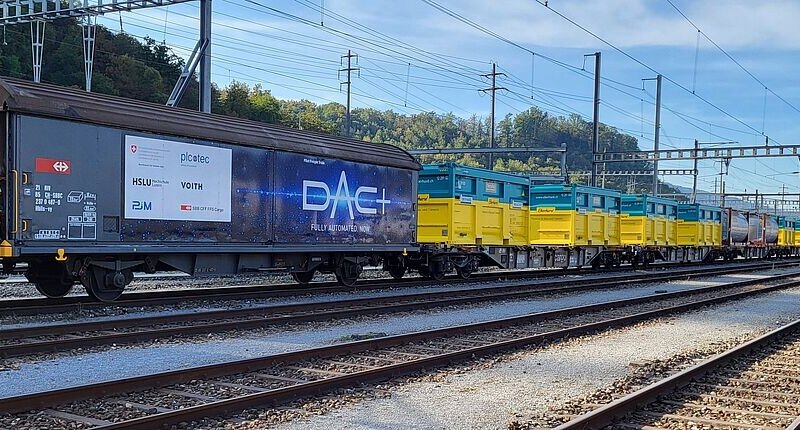
As part of an ongoing European Union (EU) project, Swiss experts have introduced a technology that enables digital communication across entire freight trains. Central to the development was a collaboration between SBB Cargo from Bern, Lucerne University of Applied Sciences and Arts (HSLU), and the HSLU spin-off plc-tec, which is based in Hägglingen in the Swiss canton of Aargau.
These Swiss organizations were all involved in a Europe’s Rail Flagship project run by the EU and entitled «TRANS4M-R Transforming Europe’s Rail Freight». The project brought together over 50 partners, including rail transport companies, industrial suppliers, SMEs, universities, and research institutions. The goal was to develop new technological concepts for fully digital freight trains as well as seamless rail freight operations.
Rail freight is set to become the backbone of a low-emission, resilient logistics chain across Europe. However, to address rising demand and network congestion, productivity needs to be increased. This is where the digital freight train – equipped with technology such as Digital Automatic Coupling (DAC) – plays a central role. The aim is to enable automation and digitalization functions, resulting in cost savings for processes that are currently predominantly manual.
«We contributed our technology for a train-wide communication system, Powerline PLUS Train Backbone PTB,» explained plc-tec Co-founder and CEO Ulrich Dersch. Until 2021, Dersch was Head of the globally recognized HSLU Competence Center for Intelligent Sensors and Networks, which specializes in data communication over power grids (Powerline Communication, PLC) and was also involved in the EU project. Based on PLC, PTB functioned as the backup technology for Single Pair Ethernet (SPE). By summer 2025, PTB had been used to successfully field test each and every train function.
According to Dersch, this shows that PTB meets all the requirements for the backbone of the digital freight train, connecting systems throughout the entire vehicle. The existing electrical train power line can be used for data transmission via PLC, eliminating the need for both an additional data network with numerous cables running throughout the train and connectors in the couplings – the latter being particularly prone to failure with the demands of coupling and operation. Overall, this helps minimize costs around procurement, installation, and maintenance – «a significant advantage for rail freight transport, which is struggling with tight margins,» said the expert.
This international collaboration was supported by Euresearch, the contact point for the European Framework Programme for Research and Innovation. «Like with previous projects, this support, along with that provided by the State Secretariat for Education, Research, and Innovation (SERI), was invaluable, especially at a time when Switzerland was not an associated European R&D framework programs member,» said Dersch.
He emphasized that through its participation and the results achieved, Switzerland has solidified its reputation as a railway technologies and standards pioneer. According to the requirements of the Swiss Federal Office of Transport, such a backbone must be «robust, affordable, and readily available». Ulrich Dersch concluded: «In this project, with PTB we have introduced a validated solution for the European-level backbone that precisely meets these requirements.»