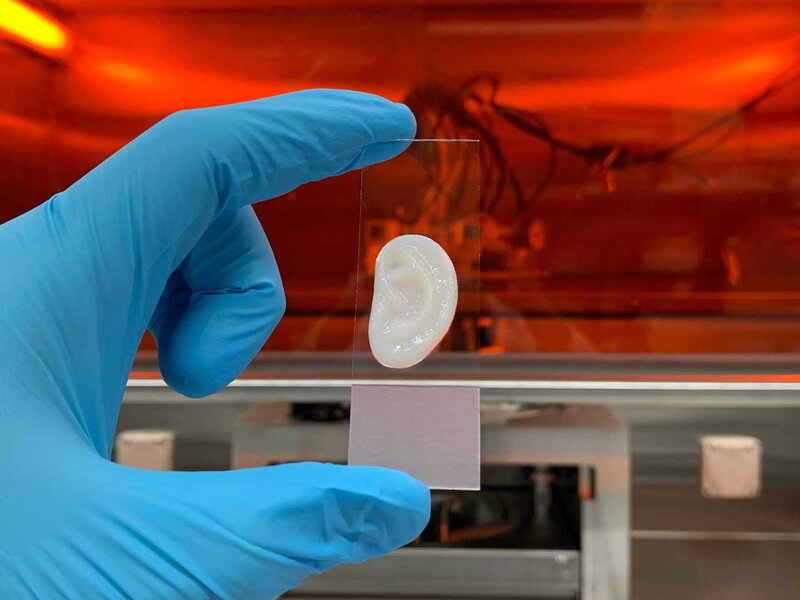
Zurich/Lucerne/Basel - Researchers are working on the development of an artificial ear. Ear cartilage generated from human cells has remained dimensionally stable in animal models. The Swiss
Lucerne/Basel/Zurich- Researchers are working on the development of an artificial ear. Ear cartilage generated from human cells has remained dimensionally stable in animal models. The Swiss Federal Institute of Technology Zurich, the Cantonal Hospital of Lucerne and the Friedrich Miescher Institute in Basel are involved in the research.
Researchers at the Swiss Federal Institute of Technology in Zurich (ETH), the Cantonal Hospital of Lucerne and the Friedrich Miescher Institute in Basel have taken another step forward in the development of an artificial ear. Using human ear cartilage cells to produce elastic cartilage in the laboratory they were able to achieve mechanical properties similar to that of natural tissue, as was reported in a statement.
As their starting material, Philipp Fisch and his team extracted cells from small cartilage remnants removed in operations to correct the shape of patients’ ears. These were cultivated in cell cultures to produce sufficient quantities for a base substance. The major challenge here is to promote the formation of type II collagen cells, which are typical of ear cartilage. In addition to the special collagen, the protein elastin must also be produced. This is a protein that gives the ear its flexibility. A mixture of elastin, collagen II and sugar-like glycosaminoglycans was embedded in so-called bioink. This gel-like material was formed into the shape of an ear using a 3D printer and then placed in an incubator to mature for several weeks. «We optimised cell proliferation, adjusted the material properties, increased the cell density and controlled the maturation environment more effectively,» commented Philipp Fisch. The ear constructs were implanted subcutaneously in rats and the material proved to be stable for a period of six weeks.
«Despite this major success, elastin remains a challenge for us, as we were not able to mature it fully,» explained Fisch. The researchers hope to achieve stability in the laboratory within the next five years, and clinical studies would be the next step. Engineered ear cartilage is the subject of keen interest, as a way to help those who have lost their ears due to fires and accidents. Or children suffering from the rare condition of microtia, so congenital malformation of the outer ear. The latest study has been published in the journal Advanced Functional Materials.